

Key takeaways
Instructional coaching works by replacing vague judgment with one specific, practicable step. The same process applies directly to student writing feedback.
This guide walks through the coaching cycle as five usable steps, then shows exactly how to apply each one to a rubric and a stack of essays.
AI gets its own section below, since it is the part of this process that breaks down first at full class size.
None of this requires a formal coaching program. Just a rubric and a willingness to give one specific piece of feedback at a time.
Introduction
Most instructional coaching content is written for people running a coaching program, cycles, models, how to train coaches, whether inside a professional development calendar, a professional learning community, or a formal instructional leadership initiative.
That content usually lives inside a school’s broader professional development calendar, workshops, PD days, professional learning communities.
This guide is different. It walks through the actual mechanism that makes coaching work, then shows how to apply that same mechanism to student writing feedback, step by step.
An instructional leader still defines the coach’s role before any of that starts, but the mechanism underneath holds up without the surrounding infrastructure.
What is instructional coaching?
Instructional coaching pairs a teacher with a coach who conducts structured classroom observations of specific practice and designs one concrete next step. It replaces a general judgment of the lesson with something the teacher can actually rehearse. The question of what is instructional coaching becomes clearer when the process is viewed as targeted practice rather than a general evaluation.
A music teacher does not say “play better.” They isolate one measure and one fix, then have the student practice it before moving on. Instructional coaching applies that logic to classroom instruction.
This differs from a typical observation, which usually rates whether a lesson went well overall. Coaching pinpoints one specific, practicable change instead of a general impression.
How to run a coaching cycle in five steps
A coaching cycle breaks a large goal into steps small enough to actually practice. These five steps are the process most instructional coaching models are built around.
This breakdown draws on the same principles as Jim Knight’s Impact Cycle, the identify, learn, improve model that much of the educational research on instructional coaching builds from.
Step 1: Identify the target performance
Describe what strong practice actually looks like, specifically enough that two observers would agree on it. Vague goals produce vague coaching. This clarity is what every later step depends on.
Coaches sometimes call this the goal-setting stage, since everything downstream depends on how precisely it’s defined.
Step 2: Find the single biggest gap
Not every issue is worth coaching on at once. Pick the one change most likely to move outcomes, and set the rest aside for later. Trying to fix everything at once usually fixes nothing.
Data analysis, whether observation notes or a stack of student work samples, is usually what surfaces this gap in the first place.
Step 3: Break it into one practicable step
Make the step small enough to rehearse in one sitting, not a full rewrite of your lesson plans. Co-teaching is one structure some schools use instead of one-on-one coaching, but this same small-step logic still applies inside it. Bigger changes overwhelm rather than help. Small steps are also easier to verify actually happened.
Step 4: Rehearse before it counts
Practice the step under low-stakes conditions first, the way a musician rehearses before a performance. This is where the new behavior actually sticks. Skipping rehearsal is the most common reason coaching fails to transfer.
This is also where specific teaching strategies get tried out quietly, before a class is watching.
Step 5: Give feedback, then raise the complexity
Once the step holds reliably, layer in the next one. This incremental pace is what makes coaching outlast the coaching session itself. Moving too fast undoes the gains from the step before it.
Providing feedback at this stage should point at the next specific step, not summarize the whole lesson or essay at once.
Effective feedback for teachers follows the same principle: it identifies one observable action to improve rather than offering a broad evaluation of the entire lesson.
The same pattern applies when a teacher tracks student writing growth across assignments: each assignment should target one criterion deeper than the last.
How to apply instructional coaching strategies to student feedback
The same five-step logic transfers directly to grading and feedback. It matters most for literacy coaches, since a writing rubric already functions as the target performance a coach would otherwise have to design from scratch. Broken into short steps, here is what that looks like in a writing classroom. These instructional coaching strategies help teachers turn broad rubric expectations into specific actions students can practice.
Treat the rubric as your target performance
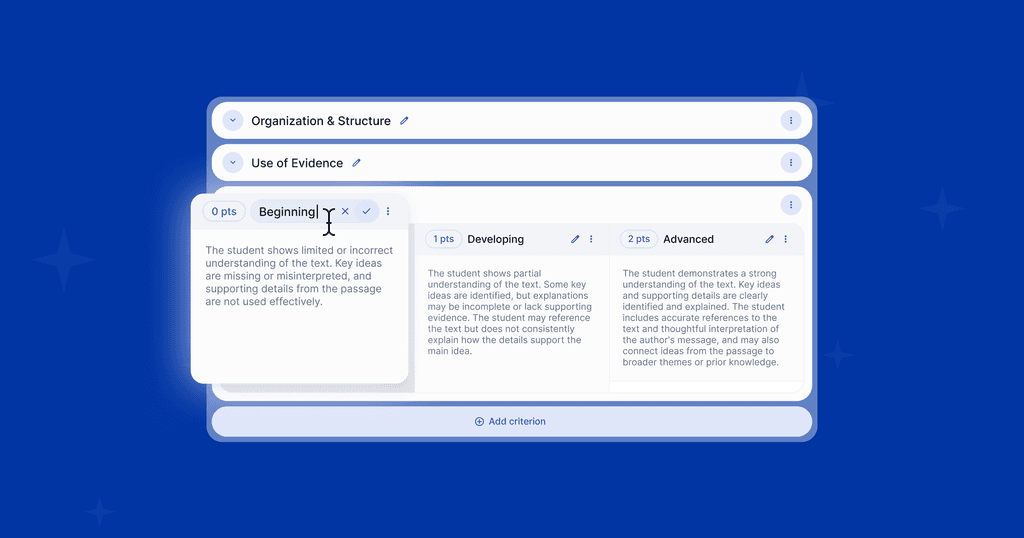
A rubric plays the same role a target performance plays in a coaching cycle. It defines strong work criterion by criterion, not as one vague overall impression. Vague rubric language produces vague feedback the same way vague coaching goals do.
Expert teachers build grading rubrics with specific score-point descriptions for exactly this reason: the clearer the target, the more specific the feedback can be.
Give one criterion of feedback at a time
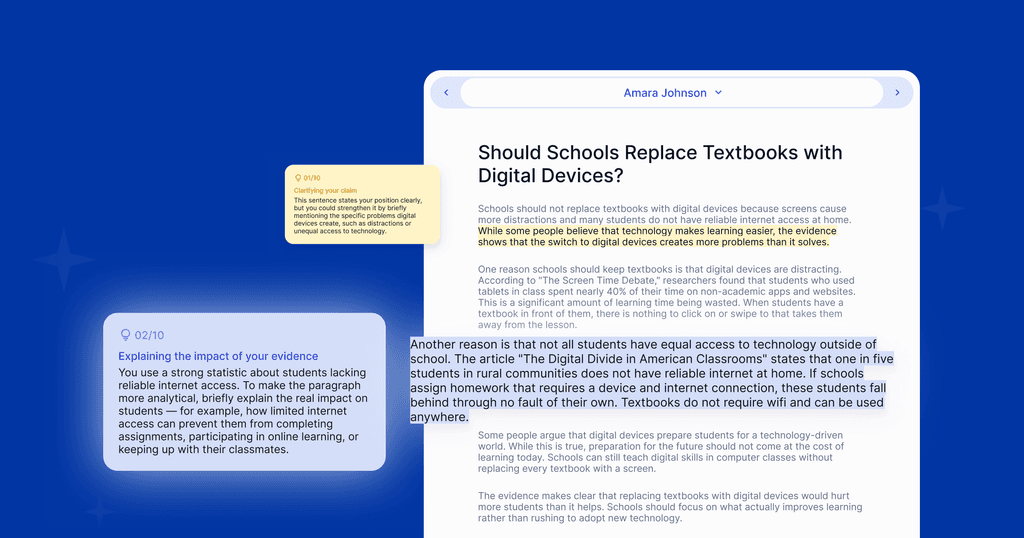
Naming one specific rubric criterion, with an example from the student’s own writing, is the coaching equivalent of a bite-sized step. It gives the student exactly one thing to practice next. Covering every criterion at once produces the same overwhelm a full lesson redesign would.
Build in a rehearsal draft before the stakes are high
A low-stakes first draft, reviewed for one criterion only, mirrors the rehearsal stage of a coaching cycle. Students practice the fix before it affects a final grade. This is the step most classrooms skip under time pressure.
Returning consistent feedback in early grades on the same criterion across multiple practice drafts is where this principle does the most work, especially at the grades where writing habits are still forming.
Raise the bar one criterion at a time
Once a student consistently hits one criterion, shift the feedback focus to the next. Asking for everything at once is the writing equivalent of a full lesson redesign in one session. Sequencing criteria this way keeps growth visible and specific. For more quick wins in the same spirit, see grading tips for teachers.
Where instructional leadership tools like AI extend this principle
This entire model has one practical limit: scale. A coach can only work this closely with a few teachers. A teacher giving this level of specific feedback runs into the same wall with a full class load.
The goal throughout, whether coaching a teacher or grading an essay, is measurable improvement: stronger student engagement, better learning outcomes, and lasting gains in student achievement.
The scale problem instructional coaching runs into
Specific, criterion-by-criterion feedback takes real time per student, which is where instructional coaching becomes difficult to sustain across a full class. A teacher with 150 students a day cannot sustain coaching-level specificity by hand across every essay, every week.
How AI-calibrated feedback closes that gap
A rubric-trained ai essay grader applies the same specificity a coach applies, one criterion at a time, consistently across a full class set. See ai grading feedback for what that output actually looks like.
Why calibration still matters more than the tool itself
Just as a coach needs grading rubrics with real specificity to coach well, an AI needs the same. The calibration process behind training an ai teaching assistant mirrors the rehearsal stage of a coaching cycle directly.
What this looks like at scale
Paired with a matching ai grading tool, grading consistency at scale becomes achievable across an entire department, not just one classroom.
See what makes ai grading accurate and grading accuracy for how specificity and consistency compound at scale.
This holds at every grade level. See student writing growth for how that consistency compounds over a semester.
Coaching conversations are stronger when they account for teacher time management alongside instructional goals.
Give students the kind of feedback coaching is built on with EnlightenAI
Coaching only works on top of relationship building. The specific-feedback mechanism below is what turns that trust into measurable gains in professional practice. If you have ever spent Sunday evening catching up on essays that were supposed to be returned Friday, the real problem is not just time. A rubric-trained TA grades against your standard, so the feedback you return still sounds like yours.
Start with the assignments already on your desk. Get started for free.
FAQs: Instructional Coaching
Instructional coaching pairs a teacher with a coach who designs one concrete, practicable next step, rather than a general judgment of the lesson.
Traditional coaching and mentoring both draw out an answer through self-reflection and questions, with the coach acting as one of several thought partners rather than an expert. Instructional coaching directly teaches a specific next step the coach has expertise in.
Identify the target performance, find the biggest gap, break it into one small step, rehearse it, then raise the complexity. Each step stays small enough to actually practice.
Yes. The same specificity applies directly to student writing feedback. A rubric-referenced comment on one criterion gives a student the same practicable step a coach gives a teacher.