
Key takeaways
Writing growth is hard to track because consistent rubric-aligned scoring at scale has been nearly impossible.
Core obstacles: grading takes too long, scoring varies between teachers, data never reaches leadership.
Real growth data needs rubric-level resolution — which dimensions improved, not just an overall score.
AI scoring is the prerequisite — inconsistent rubric application makes growth data unreliable.
EnlightenAI's Growth Analytics shows proficiency trends and insights filterable by school, grade, and teacher.
You can tell a student improved at math because the scores go up. You can track reading growth with MAP or i-Ready. But writing? Writing growth has always been the black box of K-12 data.
Not because it doesn't matter — everyone agrees it does. But because tracking student writing growth requires consistent rubric-aligned scoring across multiple assignments, over time, at scale. And until recently, that has been nearly impossible for most schools to pull off.
The result is a frustrating gap: teachers know their students are becoming better writers, but they can't prove it with data. School leaders want to see writing proficiency trends across classrooms and grade levels, but the information doesn't exist in any usable form. And when it comes time to make decisions about curriculum, professional development, or intervention, writing is the one subject area where leadership is essentially flying blind.
This post is about how to close that gap — what it actually takes to measure student writing progress over time, why most schools haven't been able to do it, and how the right infrastructure makes it possible.
Why Tracking Student Writing Growth Is So Hard
The challenge isn’t philosophical. Everyone agrees that writing should be assessed frequently, scored consistently, and analyzed over time. The problem is operational.
Scoring takes too long. Without an AI writing grader, a single round of rubric-aligned essay grading for 120 students can take a teacher 10-12 hours. Do that across multiple assignments and the math breaks down fast. Most schools simply can’t generate enough scored data points to build a meaningful picture of growth.
Consistency varies. Even when teachers grade frequently, calibration against a scoring rubric drifts from teacher to teacher and even assignment to assignment. Without consistent scoring, comparing performance across time is unreliable — you’re not measuring student growth, you’re measuring scorer variation.
Data doesn’t roll up. When individual teachers grade in isolation, results live in spreadsheets, gradebooks, and filing cabinets. There’s no system that aggregates rubric-level writing scores across classrooms, schools, or a district in a seamless way that leadership can actually use.
The net effect: schools have plenty of writing happening, but almost no longitudinal writing data. And without that data, tracking student writing growth over time is guesswork.
This is exactly the kind of structured, ongoing support instructional coaching is built to provide.
Consistent evidence starts with well-chosen formative assessment examples that reveal progress between larger assignments.
What Meaningful Writing Growth Data Actually Looks Like
If you could design the ideal system for tracking student writing progress, it would have a few properties.
Rubric-level resolution. You don't just want to know that a student's "writing score" went up. You want to know which dimensions improved. Did organization get stronger while evidence use stayed flat? Are conventions improving faster than analysis? Rubric-level data tells you where growth is actually happening — and where it isn't.
Multiple data points across time. Two snapshots aren't enough. Growth becomes visible when you can see performance across three, four, or more assignments using the same or similar rubric. That's when trends emerge and you can distinguish real improvement from assignment-to-assignment noise.
Filters that let you disaggregate. A district-level average is useful, but the real insight comes when you can break it down — by school, by grade level, by teacher, by course, and by student demographic group. That's how you identify which classrooms are driving growth and which need support. That’s how you spotlight and scale up best practices.
Writing fluency metrics alongside rubric scores. Curriculum-based measurement data — words written, correct word sequences, words spelled correctly — provides a complementary signal. When fluency metrics move in the same direction as rubric scores, you have strong evidence that students are developing as writers.
AI-generated insights, not just charts. Raw data is only as useful as the analysis layered on top. The best growth data comes with plain-language interpretation: what are the strengths across this cohort, where are the gaps, and what should instruction focus on next?
A clear synthesis essay outline gives students something concrete to revise against as this kind of growth data comes in.
How EnlightenAI Makes It Possible to Track Writing Growth
This is exactly what we built our new Growth Analytics tool to do, layered on top of the same essay grading AI teachers already use every day. It’s available now for all Clever-synced school and district partners, and we’re working on expanding access soon.
Here’s how it works: from the admin console, you select multiple assignments that share the same rubric:
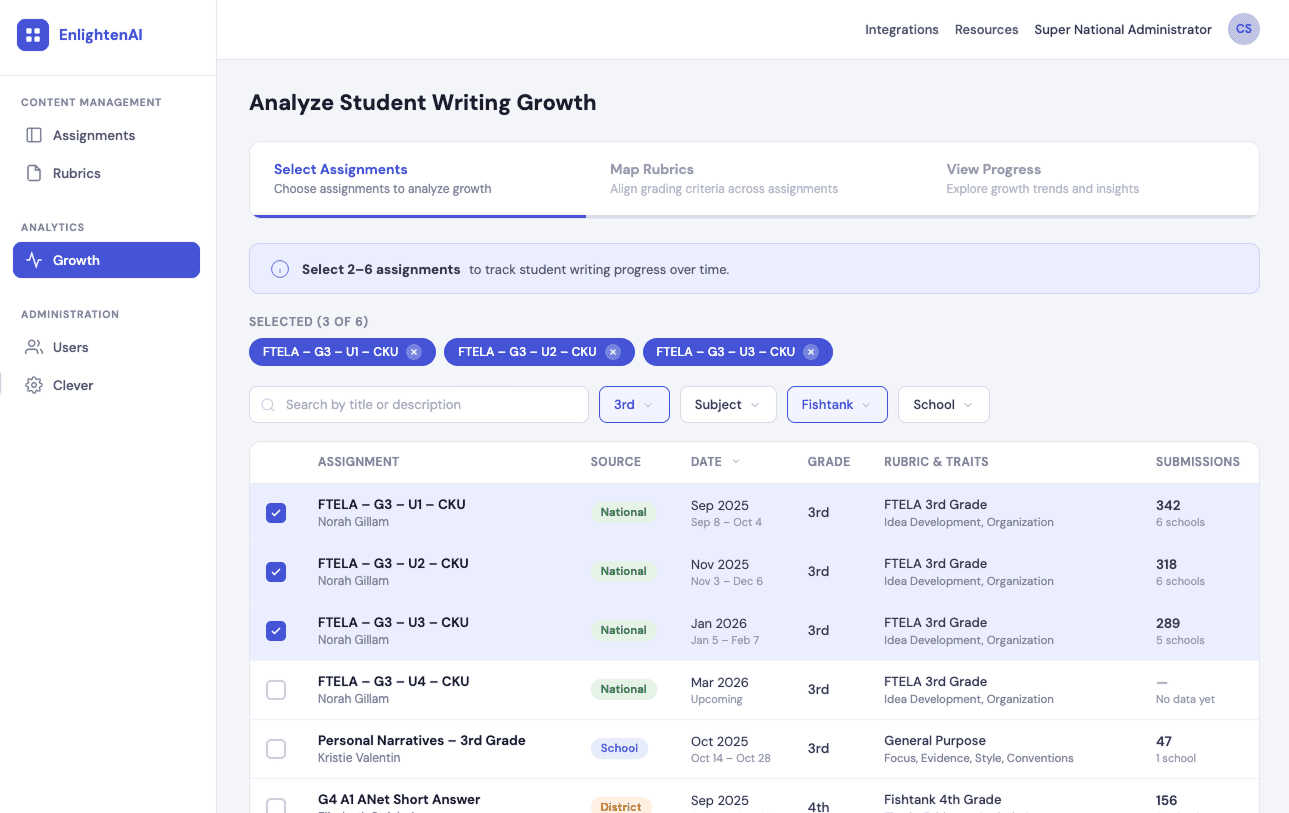
The system validates that the rubrics are comparable — same number of criteria, same point scales — and then generates a complete longitudinal view of student writing growth across those assignments.
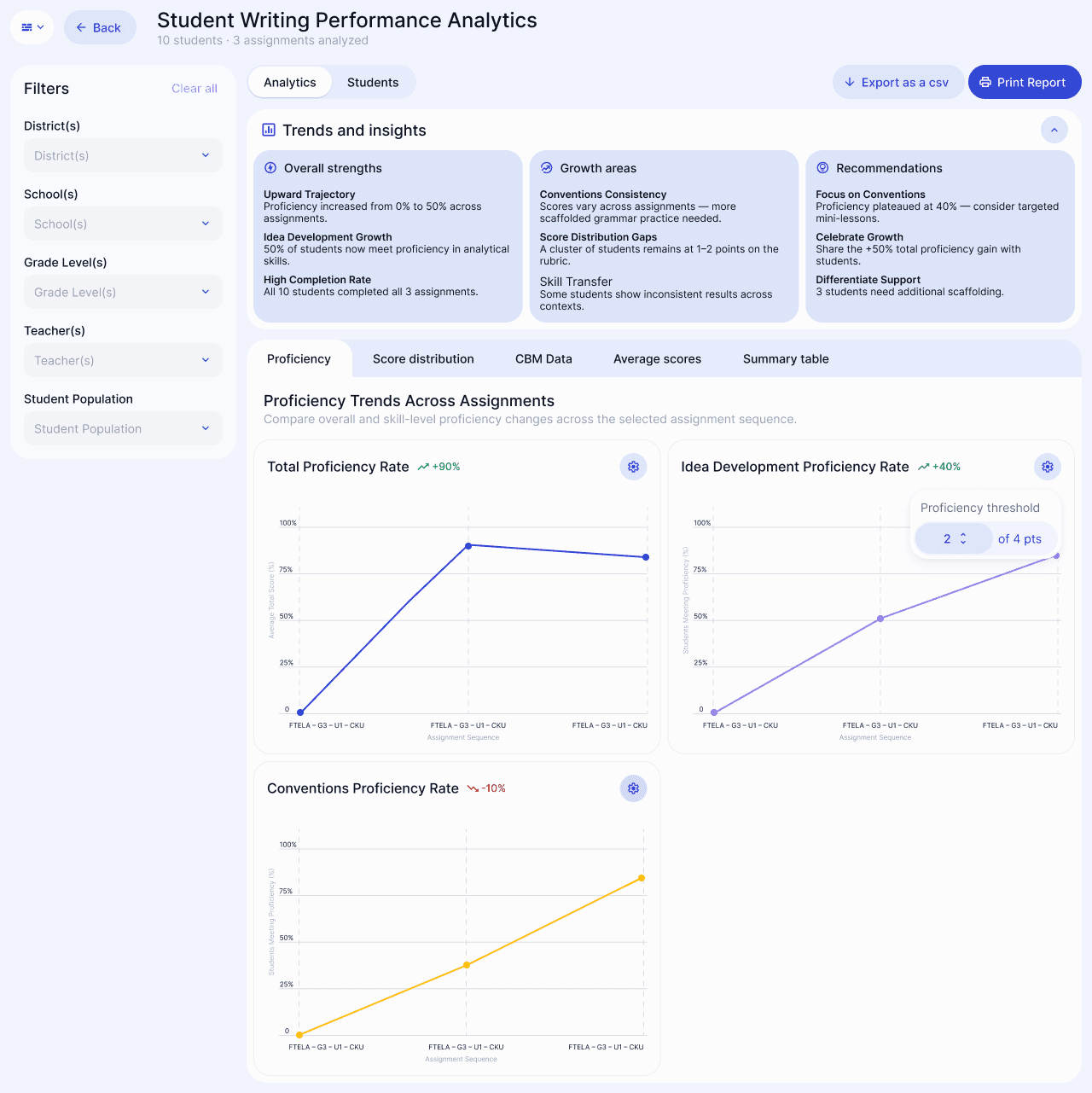
Proficiency trends show you, for each rubric category, what percentage of students are meeting your proficiency threshold — and how that rate is changing over time. You can adjust the threshold to match your definition of proficient, and the numbers update instantly.
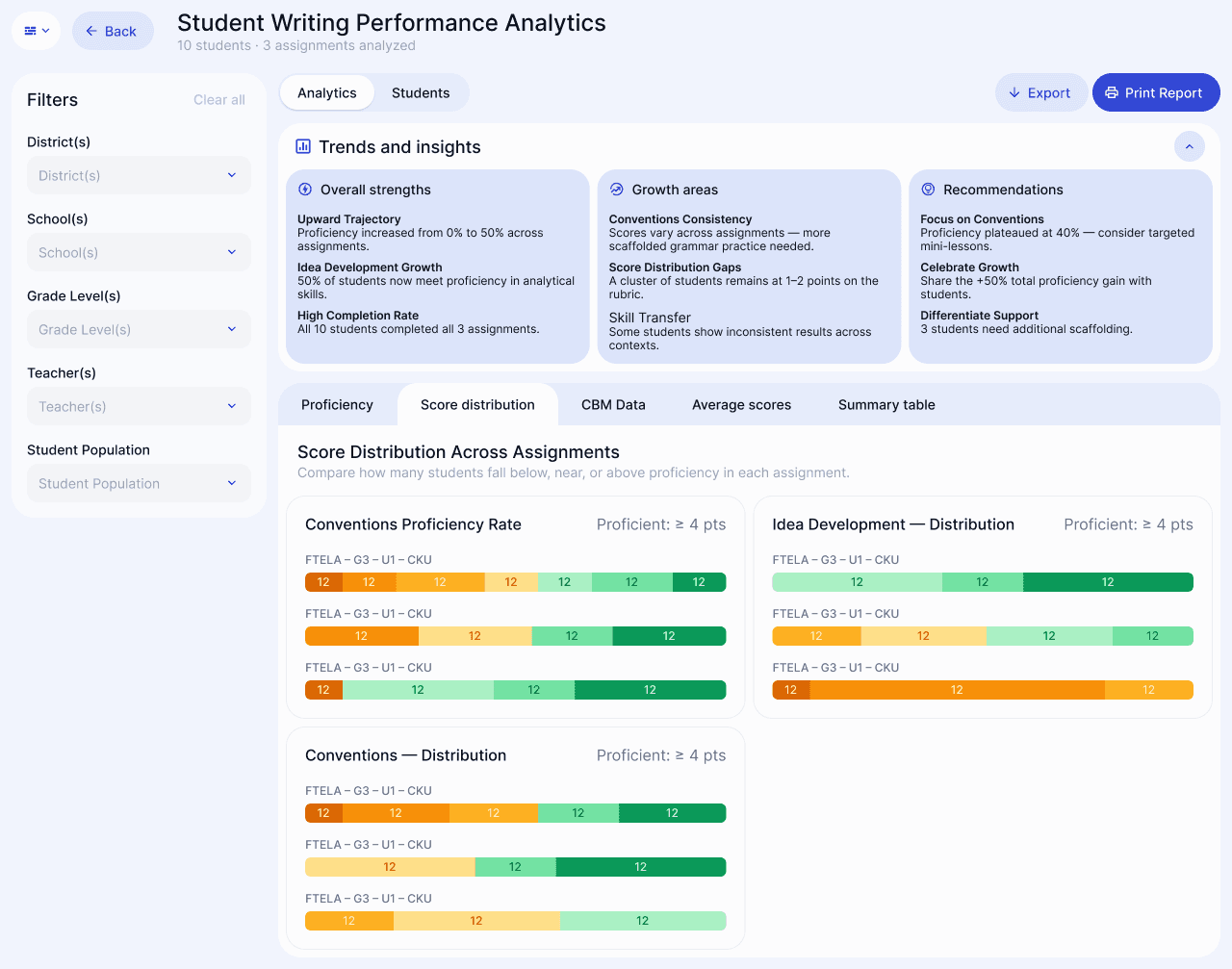
Score distributions visualize how the full range of student performance is shifting. You want to see green (proficient) growing and lower bands shrinking. When that’s happening, you know instruction is working.
Writing fluency metrics — words written, correct word sequences, words spelled correctly — are tracked alongside rubric scores, giving you a multi-dimensional picture of student writing development.
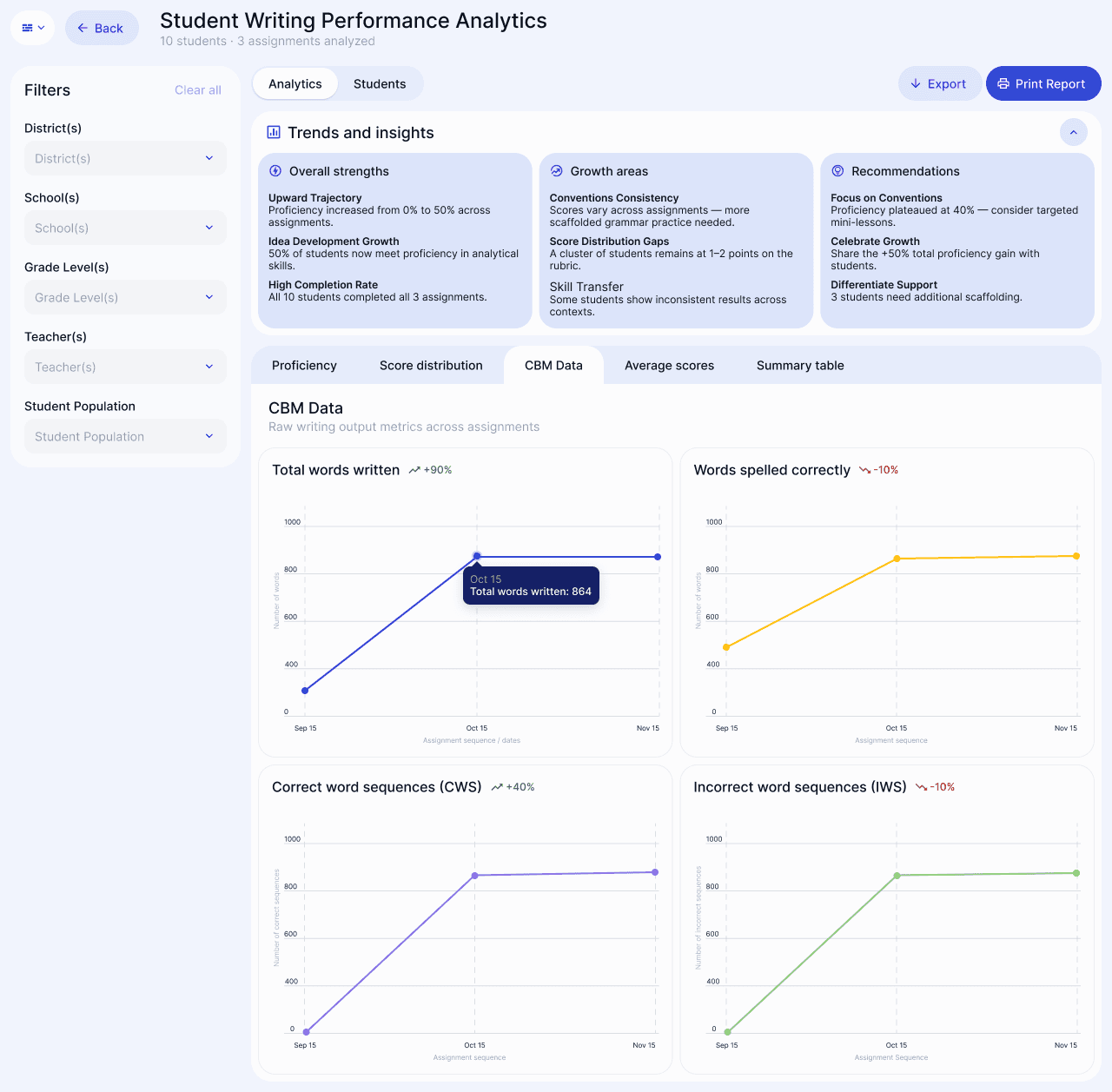
For all of these trends, you’ll receive AI-generated insights that surface the patterns in plain language: what’s strong across the cohort, where growth areas remain, and specific recommendations tied to what the rubric data is showing. No more staring at a spreadsheet trying to figure out what it means.
And crucially, every view is filterable — by school, teacher, grade level, course, and student demographics — so you can drill into exactly the questions you need answered.
🎥 Watch a 5-minute walkthrough of Growth Analytics to see how it works in practice.
A reliable review rhythm can start with time blocking for teachers so evidence is examined consistently.
A consistent essay grading ai gives schools a stronger basis for tracking growth over time.
A consistent essay grading workflow makes progress data easier to review over time.
An ai rubric generator can support consistent criteria when measuring writing growth.
Consistent ai writing feedback gives teachers useful evidence for tracking development over time.
Tracking ap lang essay grader requires consistent criteria across assignments and time.
Consistent use of an ai essay grader can make writing progress easier to measure over time.
Why This Matters for Schools and Districts
For individual teachers, growth data validates the work they're already doing and shows them where to focus next. For school and district leaders, it provides something that has never existed at scale: a continuous, comparable picture of writing achievement across classrooms and over time.
That data changes what's possible. Professional development decisions can be grounded in actual student performance patterns, not anecdotal reports. Curriculum investments can be evaluated based on measurable writing outcomes. And schools can finally answer the question that matters most: are our students becoming better writers?
Schools and districts across the country — including KIPP, Uncommon Schools, and DREAM Charter Schools — are already using EnlightenAI to build the kind of writing data infrastructure that makes this possible. Growth Analytics is the next step: turning all of that scored writing into a picture of progress that everyone from the classroom teacher to the chief academic officer can see and act on.
Visible progress like this is also one of the more reliable student engagement activities available to teachers. Pairing that data with an ai lesson plan generator turns growth trends into next-day instruction, not just a report.
Ready to see Growth Analytics in action? Book 20 minutes with our team to learn how EnlightenAI can help your school or district track student writing growth.
Growth data is only as reliable as the scoring consistency behind it
Tracking writing growth requires one thing above all else: a consistent scoring standard across every checkpoint. If rubric interpretation drifts, or if different teachers score differently, the growth data is meaningless. Consistent AI scoring is the prerequisite that makes growth tracking worth doing.
Start building data you can actually act on, try the AI grading tool.
Measuring growth means measuring the same thing each time
A semester-long writing portfolio only tells a story if every checkpoint used the same measurement standard. When the AI essay grader applies the same rubric at every checkpoint, the scores are directly comparable, not approximately, but exactly. Comparable data is what turns a collection of essays into a growth trajectory.
This works especially well once teachers are comfortable ai for essay grading at the pace growth tracking requires.
Apply the same rubric at every checkpoint, try the AI essay grader.
STAAR growth tracking that uses the actual STAAR rubric
Texas teachers who track writing growth have a specific target: STAAR performance. Generic essay rubrics don't produce data that maps onto that target. Running checkpoints through the STAAR writing grader means every growth measurement uses the same criteria students will face on test day. STAAR-aligned scoring is the only kind that predicts STAAR performance.
Make your growth data STAAR-relevant, try the STAAR writing grader.
FAQ
The most reliable way to track student writing growth is to score multiple assignments against the same rubric over the course of a semester or year, then analyze proficiency trends at the rubric-category level. This requires consistent scoring — which is where AI-powered tools like EnlightenAI help, by ensuring rubric application is calibrated and comparable across every assignment.
Reading and math have standardized benchmark assessments (like MAP or i-Ready) that produce comparable scale scores across time. Writing doesn't have an equivalent — it requires human or AI scoring against rubrics, which introduces variability. Tracking writing progress at scale requires infrastructure that ensures scoring consistency and aggregates rubric-level data automatically.
Yes. AI writing assessment tools can score student work against rubrics consistently and instantly, generating the volume of comparable data points needed to track growth. EnlightenAI's teacher-calibrated AI produces rubric-aligned scores with a 0.77 QWK agreement rate — higher than typical human-to-human scoring consistency — making longitudinal writing data reliable and scalable.
School leaders should track rubric-level proficiency rates over time, score distributions across assignments, writing fluency metrics (words written, correct word sequences), and disaggregated data by school, grade, teacher, and student demographics. This combination provides a complete picture of where writing growth is happening and where gaps remain.
Growth Analytics lets school and district partners select multiple assignments that share the same rubric, then generates proficiency trends, score distributions, writing fluency data, and AI-generated insights — all filterable by school, teacher, grade level, and demographics. It's available now for Clever-synced partners, with expanded access coming soon.