
Key takeaways
14 differentiation strategies organized by content, process, product, and environment, the standard framework for planning differentiated instruction.
A dedicated section covers differentiating writing feedback and grading, a gap in most general differentiation resources.
Tiered rubrics and AI-calibrated feedback let differentiation scale across a full class set, not just a few conferences.
Every strategy works with materials teachers already have. No new curriculum or platform required.
Introduction
Differentiated instruction, sometimes called differentiated learning, adapts teaching to match students’ readiness, interests, and learning needs, instead of delivering the same lesson the same way to every student.
The 14 strategies below are organized around the standard planning framework developed by education researcher Carol Ann Tomlinson: content, process, product, and learning environment. A final section covers grading rubrics and feedback specifically, a piece most differentiation resources skip entirely.
At the small-group and single-student level, this is individualized instruction, not just a whole-class delivery adjustment. For the grading side, ai essay grader shows how tiered rubric scoring holds up at full class size.
Differentiating content: what students learn from
Content strategies change the materials students use to access the same learning objective. The objective stays constant; the entry point adjusts to readiness or interest.
1. Leveled reading sets
Provide the same topic at two or three reading levels. Every student engages with the same content, at a level they can actually access, which keeps the focus on reading comprehension instead of decoding difficulty. This keeps the whole class on the same unit without leaving anyone behind or under-challenged.
2. Curated skill-based practice sets
Organize practice problems by difficulty for the same skill. Students work at their level and move up as they show mastery. A quick check-in tells you when a student is ready for the next tier.
3. Multimedia resource stacks
Pair text with video, audio, graphic organizers, and other multimedia resources that explain the same concept. Students choose the format that helps the idea land. This is especially useful for concepts that resist a single clean explanation.
4. Interest-based content options
Let students explore the same skill through topics tied to their own interests. Motivation rises when the content feels personally relevant. A quick interest survey at the start of a unit is usually enough to plan this.
Thoughtful differentiation works best when teachers can protect planning time for responsive instruction.
Differentiating the process: how students practice a skill
Process strategies adjust how students work through material, not what they are learning. Pace, grouping, and support level are the levers here.
None of this replaces direct instruction, it changes how much scaffolding surrounds it.
5. Flexible grouping and small-group instruction
Flexible grouping means grouping students by current skill gap, not fixed ability level. Regroup as soon as formative assessment data shows a gap has closed. Groups should shift week to week, not stay fixed for a full semester, driven by ongoing assessment rather than a set schedule.
6. Tiered assignments
Offer the same learning objective with targeted support at different levels. A student assembling labeled steps and a student writing from scratch can target the identical skill. Both walk away having practiced the same objective.
7. Scaffolded instruction
Use a gradual release model, heavy support at first, less as students build confidence. Adjust how long each stage lasts by student need. Some students move through the release faster than others, and that is expected.
For younger students, early grades feedback can provide the additional clarity they need while moving from guided practice toward more independent work.
8. Varied pacing and timing
Give some students extended time to complete work with support. Give others time to explore the same material in more depth. Both uses of extra time serve the same underlying goal: mastery, not just completion.
Differentiating the product: how students show understanding
Product strategies let students demonstrate the same learning objective in different formats. The standard being assessed does not change; the output format does.
9. Choice boards for demonstrating learning
Offer several ways to show understanding of one objective: a written report, a visual project, a presentation, or a set of hands-on activities. Students pick the format that lets them show what they actually know. The rubric criteria stay fixed across every option. A tic-tac-toe choice board, a 3-by-3 grid where students complete any three options in a row, is a common way to structure this menu.
10. Tiered rubrics
Keep the same core criteria across a class, but adjust score point language by readiness band. This is where product differentiation meets grading directly. Consistency across the tier matters as much as the tier design itself.
See how expert teachers build rubrics for what specific score-point language looks like in practice, and how it changes what the AI can actually calibrate to.
11. Learning contracts
Set an agreement with each student on pace, format, or focus for a project. Students gain ownership while still meeting the same objective. A short check-in partway through keeps the contract on track.
Tracking student writing growth across contracts is what turns a one-off structure into a repeatable differentiation approach.
Differentiating the learning environment
Environment strategies shape the physical or structural space around learning. They support the other three categories rather than replacing them.
Strong classroom management is what makes moving between these spaces possible without losing instructional time.
12. Flexible seating zones
Designate quiet, individual-work areas alongside collaborative learning zones. Let the task determine which zone a student uses that day. The same student may need both zones across a single class period.
13. Learning stations
Set up rotating stations with varied tasks tied to one topic. Complexity can vary station to station without changing the topic. This gives every student a way into the material at their own level.
14. Peer support structures
Pair students intentionally, similar readiness for reinforcement, or mixed readiness for scaffolding. A think-pair-share protocol works well here: students think alone first, then pair off based on the readiness match the task calls for. Vary the pairing model by the specific task.
Differentiating writing feedback and grading
Most differentiated instruction resources stop at content, process, and product. Feedback and grading are rarely addressed, even though they are where differentiation is hardest to sustain at scale.
A tiered rubric is only as good as its consistent application across every student in that tier. Manually tracking which tier each student needs, on every assignment, is not realistic for a full class load.
This is where ai grading feedback becomes a genuine differentiation tool. A rubric-trained ai essay grader applies tiered rubric language consistently across every student, at the depth each tier requires.
Paired with a matching ai grading tool, tiered feedback stays consistent even as class size grows. See grading consistency at scale for what this looks like across a full department.
Teachers can also prepare an ai teaching assistant around their own rubric language and expectations, helping differentiated feedback remain aligned with their instructional approach. For the fuller picture of what these tools deliver, see benefits of ai in education.
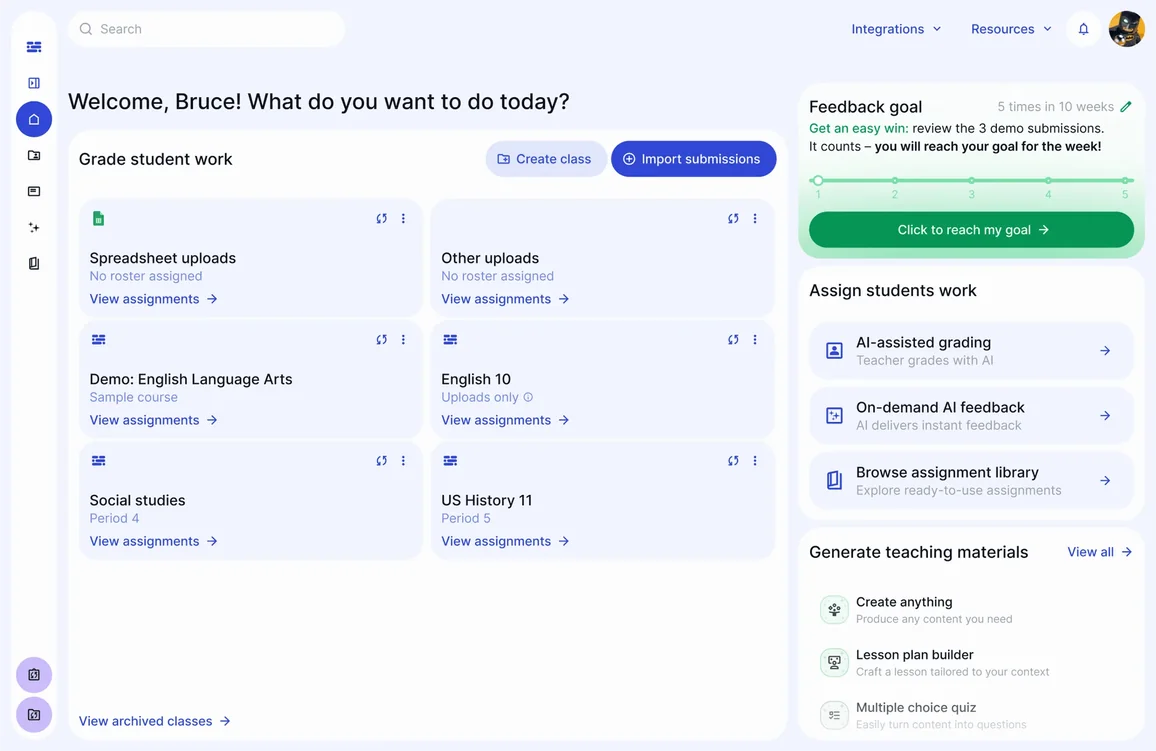
Apply tiered rubrics consistently with EnlightenAI
If differentiating feedback works for one class but not five, the problem is not the tiers themselves. A rubric-trained TA applies your tiered criteria consistently, at whatever depth each student’s tier needs.
Start with the assignments already on your desk. Get started for free.
FAQs: Differentiated Instruction Strategies
Content, process, product, and learning environment are the four standard categories. Content changes what students learn from; process changes how they practice; product changes how they show understanding; environment shapes the space around all three.
Most classrooms mix these teaching methods rather than committing to just one category. The right mix depends on the specific gap you are trying to close.
Tiered assignments are one of the clearest differentiated instruction examples. Every student targets the same learning objective, but the support level built into the task adjusts to their readiness.
This keeps grading straightforward, since every version is still measured against the same core criteria. Only the scaffolding around the task changes.
Scaffolded instruction gradually reduces support for the whole class over time; tiered instruction gives different support levels to different students at once. Many classrooms use both together across a unit.
A class might move through a scaffolded release together, while individual tiers still vary within each stage. The two approaches complement rather than replace each other.
Tiered rubrics paired with AI-calibrated feedback are the most sustainable approach. The rubric defines the tiers once; the AI applies them consistently across every student, at every readiness level, without manual re-scoring each time.
That consistency is what makes differentiated grading realistic at full class size. Without it, tiered rubrics tend to drift by the end of a stack. Over a full year, that consistency also tracks with stronger student achievement across every tier, not just smoother grading logistics.
No. Learning styles theory, the idea that a student learns best when content is matched to a fixed visual, auditory, or kinesthetic preference, has not held up under research.
Differentiated instruction groups students by readiness, interest, and skill gap instead, categories with actual evidence behind them, and those groupings shift as students grow.