Key takeaways
The benefits of AI in education are real, but they're task-specific, not universal. Personalized practice, instant feedback, and admin time savings are the clearest wins.
"Instant feedback" and "personalized learning" mean different things depending on the tool. A multiple-choice quiz and an open-ended essay need different kinds of AI to do this well.
Time saved on grading is one of the most measurable benefits for teachers, but only when the AI is trained on an actual rubric, not guessing at one.
Accessibility is one of the most underrated benefits of AI in education. Text-to-speech, translation, and captioning open up classrooms that used to require separate accommodations for each student.
Best for: anyone deciding where AI is actually worth adopting first, not a blanket case for or against it.
Most lists of the benefits of artificial intelligence in education repeat the same five points: personalized learning, instant feedback, smart tutoring, accessibility, and time savings for teachers. Those are the right five, the problem is most lists stop at the label without saying what actually has to be true for each one to work.
This guide goes one level deeper on each benefit, including the one edtech content usually glosses over: what "instant feedback" actually requires to be accurate rather than just fast, which is where AI writing feedback becomes relevant specifically for open-ended writing.
The clearest form of personalization is adaptive practice: platforms that respond to student learning, learning outcomes, and learning styles by adjusting difficulty, so a struggling student sees more scaffolding and a stronger one sees harder problems. This works well for skills with a right answer, since the system can measure correctness instantly and adjust from there.
It gets harder for open-ended work like an essay, where "personalized" has to mean feedback tailored to that specific piece of writing, not just an adjusted difficulty slider. That's a different kind of AI problem, and it's what pretraining an AI teaching assistant on a rubric is actually built to solve.
For closed-ended questions, quizzes, multiple choice, and fill-in-the-blank, real-time feedback is close to a solved problem: the system knows the right answer, so it can tell a student immediately. Writing doesn't work that way, there's no single correct answer to check against, only a rubric and a judgment call.
This is the benefit most "AI in education" roundups list without qualification, and it's worth being specific about. Accuracy depends heavily on whether the tool was trained on the actual rubric being used, not a generic one, before it's fast enough to trust for feedback a student will actually read. See a direct comparison in AI grading accuracy compared to human grading.
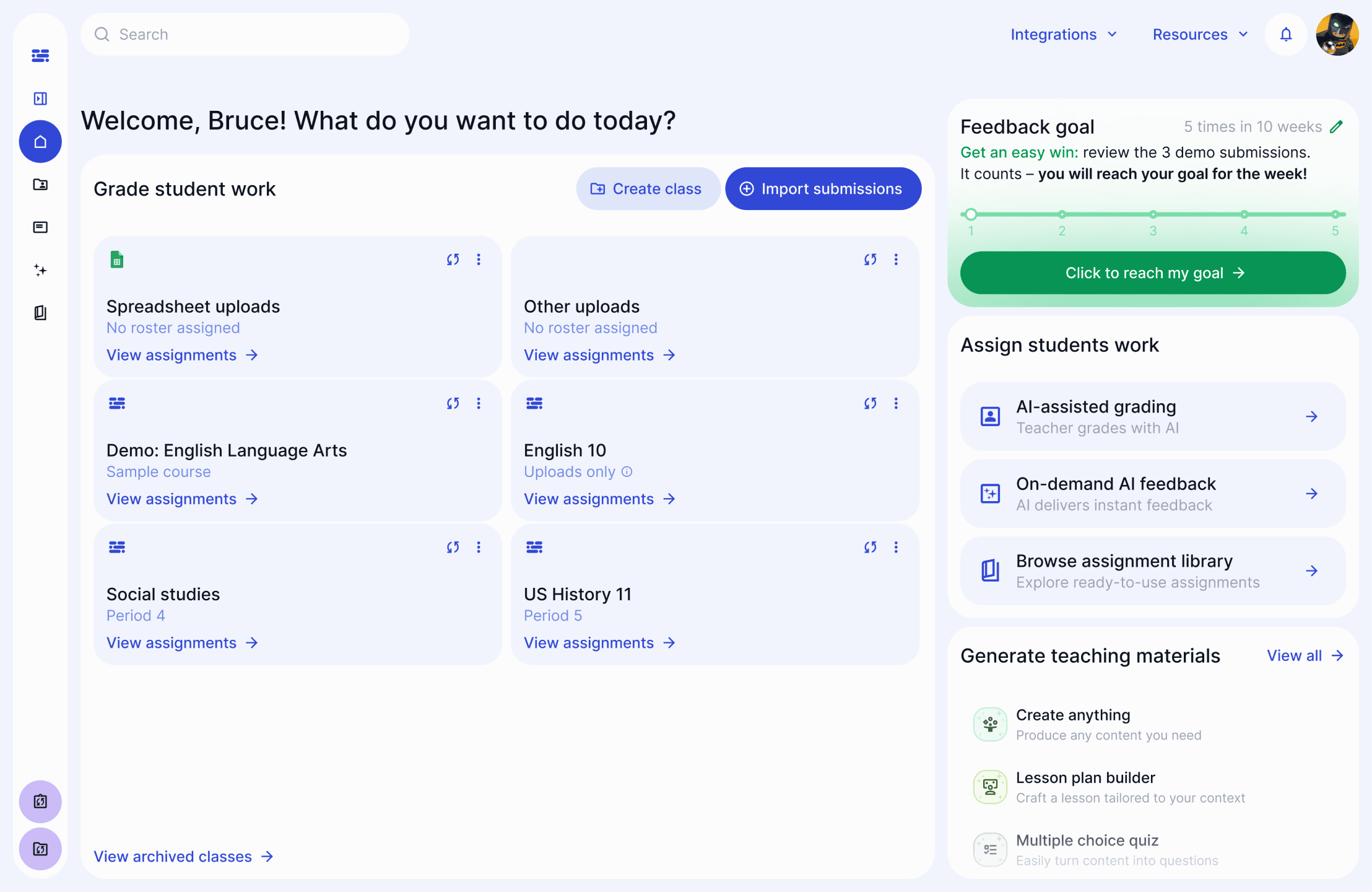
EnlightenAI helps teachers deliver instant, rubric-aligned AI writing feedback so students can practice, revise, and improve faster. It's a simple way to start grading essays more efficiently.
AI chatbots and tutors, including tools built around Khan Academy content, can walk a student through a concept with questions rather than answers, supporting critical thinking outside class hours when a human tutor isn't. The best versions ask questions instead of handing over solutions, which keeps the student doing the thinking instead of copying an answer. For more on how this looks day-to-day inside an actual classroom, see AI in the classroom.
Text-to-speech, real-time translation, captioning, and other educational resources help students with disabilities and multilingual learners access the same lesson as everyone else, often without a separate accommodation plan for each tool. This benefit gets less attention than personalization, but it changes who can participate in a lesson at all, not just how fast they move through it. Similar accommodations for attention and focus are covered in AI tools for teachers supporting ADHD students.
The practical upside for a school is that one accessibility feature often serves several different needs at once. A captioning tool built for hearing-impaired students also helps English language learners and anyone reviewing a recorded lesson later, which is part of why this benefit tends to have a bigger reach than a single-purpose tutoring or grading tool.
Automating administrative tasks such as grading is usually framed as a time-savings benefit for teachers, and for routine tasks like multiple-choice or fill-in-the-blank work, that's straightforward: the system already knows the answer. For essays and open-ended writing, the time savings depend entirely on whether the AI was trained on your actual rubric, or is guessing at one from the prompt alone. Building your actual rubric once is the difference between the two.
A general-purpose essay grader for teachers will draft a comment on one essay easily enough. It won't necessarily hold the same standard on the fortieth essay that it held on the first, which is the actual bar for this benefit to be real at classroom scale, and the same consistency question shows up again once you're comparing scores across grading accuracy at a district level.
If grading is the benefit you're evaluating AI for specifically, that consistency question is worth testing before rolling anything out. See how a rubric-trained grading tool holds up across a full class set, not just one sample essay.
Not every benefit on this list needs to be adopted at once, and rolling out generative AI tools without an implementation plan or professional development is usually how a school ends up using none of them well by spring. Start with whichever task already has the clearest right-or-wrong answer, quiz grading, attendance, or scheduling, since that's where AI is closest to a solved problem and the payoff is immediate.
Save the harder judgment calls, essay feedback, tutoring, and anything touching a student's individual learning plan, for a second phase, once a school or department has a clear rubric or framework the AI can actually be trained on. The benefit exists either way, but sequencing it this way is the difference between a tool that sticks and one that gets abandoned after a grading period.
Put the grading benefit to the test with EnlightenAI
Most of the benefits on this list are easy to agree with in the abstract. Grading is the one where "it works" or "it doesn't" shows up fast, the first time a rubric gets applied inconsistently across a stack of essays.
Start with the assignments already on your desk. Get started for free.