
Key takeaways
The synthesis essay is worth 6 points and requires citing at least 3 of 6-7 sources to support a clear, defensible position.
A five-step process, prompt, sources, thesis, outline, draft, keeps you on pace within the roughly 40-minute writing window.
The most common point losses come from summarizing sources instead of using them as evidence. Every source you cite should support your argument, not just restate it.
A strong thesis takes a defensible stance, defend, challenge, or qualify, not just restate the prompt’s claim.
Introduction
The AP Lang synthesis essay is the first of three free-response essays on the exam, and it is worth 6 of the total points available on the Free Response section.
The other two Free Response essays are the rhetorical essay, which analyzes an author’s rhetorical choices, and the argumentative essay, which asks you to build a case from your own knowledge. All three are part of the ap english language and Composition exam, scored against rubrics published by the College Board.
Around 62% of students score a 3 or higher on the full exam, and the synthesis essay is often where points are won or lost early. Getting the process right here sets the pace for the two essays that follow.
What the synthesis essay actually asks you to do
The prompt presents a claim about a topic, and your job is to take a position on it. You can defend the claim, challenge it, or qualify it by agreeing with part and disagreeing with another part.
Sources typically include 4-5 text passages plus one visual source and one quantitative source, like a chart or graph. You need at least three sources to earn full credit, though citing four gives you a safety margin.
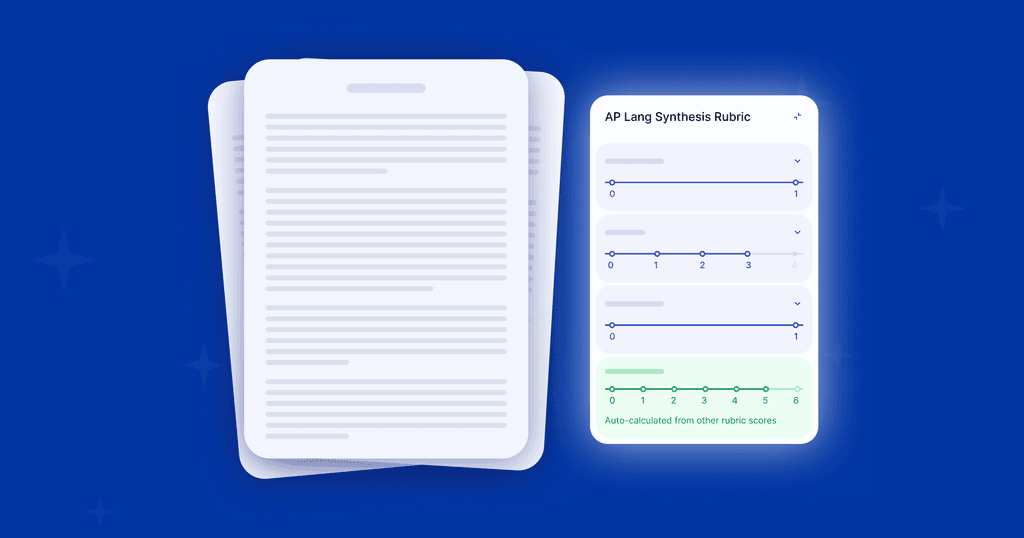
Scoring breaks into three parts:
Thesis: 0-1 point for a defensible, specific position on the claim.
Evidence and commentary: 0-4 points for how well you use textual evidence from the sources to support your line of reasoning.
Sophistication: 0-1 point for demonstrating complex understanding, not just competent argument, often shown by addressing a counterargument instead of ignoring it.
The evidence and commentary row is where most students lose points. grading rubrics with specific score-point language for each row, rather than vague descriptors, are what separate a 4 from a 2 on that criterion.
A five-step writing process for the synthesis essay
With roughly 55 minutes total for reading and writing, pacing matters as much as the argument itself. These five steps keep you moving without sacrificing quality.
Step 1: Read the prompt closely, about 2 minutes
Identify exactly what claim you are responding to before reading any sources. Do not commit to a stance yet, the sources should shape your position, not the other way around. Marking up key phrases in the prompt helps you stay anchored once you start reading, and it is also where you contextualize the claim before you have seen any evidence for or against it.
Step 2: Read and annotate all sources, about 13 minutes
Even though you only need three sources, read all of them so you pick the strongest ones. This reading period is where most of your source evaluation happens. As you read, mark whether each source supports, challenges, or complicates your emerging argument. Watch for biases in how a source frames its evidence, since that shapes how much weight the source material deserves in your argument. A quick margin note on each source saves real time when you build your outline.
Step 3: Write a thesis statement that takes a real stance
State clearly whether you defend, challenge, or qualify the claim, and preview your line of reasoning. A thesis that just restates the prompt earns zero points here. The stronger move is naming your actual position in the first sentence, not building up to it.
Step 4: Build a short outline, 5 minutes
List your thesis, then three pieces of evidence with the commentary connecting each one back to your argument. This step feels slow under time pressure, but it prevents a disorganized draft. Most of the essays that run out of time are the ones that skipped this step.
Step 5: Write the essay, about 30-35 minutes
Follow your outline and spend real attention on the commentary sentences, not just the evidence itself. Commentary is what proves you understand why the evidence matters, not just that you found it. Leave a few minutes at the end to check your grammar and punctuation, the exact language the official rubric uses for this requirement.
Strong source integration is central to polished academic writing at the AP level.
A strong ap lang essay grader depends on clear source integration and a defensible line of reasoning.
A worked example of a synthesis essay outline
Here is how the outline stage might look for a prompt about school start times, a common AP Lang topic with a clear range of source perspectives.
Prompt claim: schools should delay start times for adolescent students.
Thesis (qualifying the claim): delaying start times benefits most students, but districts must weigh the tradeoff against family and transportation logistics.
Evidence 1: A source on adolescent sleep research supports the health argument for later starts.
Evidence 2: A source on district transportation costs complicates the claim with a practical constraint.
Evidence 3: A source citing improved attendance data reinforces the case for later starts despite the logistics cost.
Notice the outline does not summarize each source, it states what each source proves and how it fits the argument. That distinction is what separates a strong response from a weak one.
Each of your body paragraphs should open with one of these topic sentences, tying the evidence back to your thesis rather than just to the source it came from.
Teachers grading a stack of these responses can see grading accuracy drop sharply when scoring criteria are not applied the same way across every essay. See what makes ai grading accurate to understand how rubric calibration improves consistency. Grading consistency at scale across a full AP Lang cohort depends on the same specificity this outline models.
Real AP Lang synthesis essay prompt topics
Verified against real released College Board materials, these are past AP Lang synthesis essay prompt topics worth reviewing before test day.
Wind farms and energy sustainability: whether to establish a large-scale wind farm, weighing environmental and economic factors, a 2019 prompt tied to broader sustainability debates.
Mapping software: the value, if any, of mapping software and GPS devices for everyday navigation, a 2025 prompt.
Presidential elections: whether television coverage of presidential elections has made them fairer or shifted focus from issues to image, a recurring classic prompt.
Mistakes that cost points on the synthesis essay
Summarizing sources instead of using them as evidence. A summary describes what a source says. Evidence explains how that source proves your specific point. This is the single most common reason strong readers still lose evidence points.
A thesis that restates the prompt. “There are pros and cons to this issue” is not a defensible position. State where you actually land, even if your position is a qualified one.
Quoting too much text from a single source. The official directions allow you to cite sources through direct quotation, paraphrase, or summary, so use short, targeted quotes and paraphrase the rest in your own words. Long quotes eat into your word count without adding analysis.
Citing a source you do not fully understand. A misread source can undercut your own argument if you use it incorrectly. If a source is confusing, it is safer to choose a different one.
Skipping the outline to save time. A rushed structure usually costs more time in the writing stage than the outline would have taken. Five minutes spent outlining is rarely five minutes wasted.
For teachers, ai grading feedback built on a specific AP Lang rubric can flag each of these patterns consistently across a class set. Student writing growth on these criteria over multiple practice essays is also what a calibrated ai teaching assistant can surface before the final exam.
Grade AP Lang synthesis essays consistently with EnlightenAI
If you are the teacher grading a stack of these essays rather than writing one, the same 6-point structure above is what makes consistent scoring difficult by hand. A rubric-trained TA grades against your specific AP Lang standard, so scoring stays consistent across every essay in the stack. An ai essay grader can help teachers maintain the same scoring standards across every submission. A dedicated ai grading tool also reduces the time required to review large sets of essays while keeping scoring consistent.
See how this works for ap english language specifically, or Get started for free with the assignments already on your desk.
FAQs: How to Write a Synthesis Essay AP Lang
You need at least three sources, though citing four gives you a safety margin if one citation is weaker than intended. More than four rarely helps and can pull focus from developing your actual argument.
Quality of use matters more than the count. Three sources used well score higher than five sources summarized poorly.
A strong thesis takes a clear, defensible position, defend, challenge, or qualify the prompt’s claim, without just restating the issue. It should also preview your line of reasoning, not just announce your stance.
Readers should be able to predict your essay’s structure from the thesis alone. That predictability is a sign the thesis is doing its job.
The essay is worth 6 points total: 1 for the thesis, 4 for evidence and commentary, and 1 for sophistication of thought. Most students lose points in the evidence and commentary section, since that is where summarizing sources instead of using them as evidence shows up most.
The sophistication point is the hardest to earn and the easiest to skip worrying about. A clear, well-supported argument without it still scores solidly.
Roughly an hour total: about 15 minutes reading and annotating sources, 5-10 minutes outlining, and 30-35 minutes writing. This is one of three free-response essays, so pacing matters as much here as the writing itself.
Running long on this essay leaves less time for the two that follow. Practicing this pacing ahead of test day matters as much as practicing the writing itself.