Michael Harbaugh
Introduction
When we first introduced EnlightenAI to KIPP New Orleans, we did not know it would lead to a regional rollout. That story starts with one teacher.
Emily Bisso is a 20-year teaching veteran, National Board Certified, and a history and social studies teacher at KIPP New Orleans. She is, by her own description, someone who asks hard questions before she commits to anything. When she heard about EnlightenAI, her first reaction was skepticism. Still, she came to a meeting and decided to give EnlightenAI a try.
That personal connection became the foot in the door. What happened next transformed how an entire KIPP New Orleans region thinks about writing, feedback, and what a teacher's time is actually worth.
[VIDEO: Watch Emily's full conversation here!]
The Problem: Grading Was Crushing Teachers
Anyone who has taught AP Government, AP World, or any writing-intensive course knows what Emily is talking about when she says the grading load is "crushing." Document-Based Questions. Long Essay Questions. Short Answer Responses. For a class of 30 students, a single weekend of grading can consume 10 hours or more, leaving teachers exhausted before Monday even begins.
Emily saw this clearly from her own experience and in the teachers she mentors. Newer teachers, in particular, would drown in data. They would spend all their time processing responses and have almost nothing left for what matters most: planning the next lesson, coaching individual students, and building the kind of classroom culture that changes a kid's life.
The challenge was not just volume. It was the cycle that volume was breaking. A great teacher does not just grade essays. She grades them, identifies trends, adjusts her approach, gives students feedback, and sends them back to revise. That whole cycle was collapsing under the weight of paper.
The Fear: What Happens to the Humanity?
Emily did not walk into AI with open arms. She was wary of adding yet another tool to an already overcrowded tech stack, and more fundamentally, she worried about what AI would take away. Teaching is a deeply human enterprise. The relationship between a teacher and a student, the moment a piece of feedback lands and changes how a kid sees themselves as a writer, the quiet knowledge a veteran teacher carries about each individual student in her room: none of that can be automated.
"I kept getting invited to these meetings about test-driving Gemini, Magic School, things like that. And I thought, I don't know.... I was worried about losing the humanity in the teaching."
That caution is not a character flaw. It is good judgment. And it is precisely why Emily's eventual enthusiasm for EnlightenAI means something.
When she started using EnlightneAI, Emily didn't not hand her gradebook over to AI and walk away. She tweaked and trained each assignment, and reviewed each piece of feedback She calibrated. She trained the tool on her rubrics. And then she did something even more valuable: she caught it being wrong.
During an AP Government concept application question about President Kennedy using the bully pulpit, many students incorrectly answered "executive order" instead of identifying the correct informal power at play. EnlightenAI marked them wrong, which was right. But in explaining why, the tool made an error of its own, incorrectly describing executive orders as a formal power when they are actually an informal one.
Students caught it immediately. And Emily turned it into a masterclass.
"It was a cool Meta moment. The AI is not human, and it is going to make mistakes. Remember this when you are using ChatGPT to tell you something. It is not infallible, and it is so easy to look at it and think that it is."
That moment is at the heart of what responsible AI integration in education looks like. A tool that helps a teacher teach students to think critically, including critically about the tool itself, is not replacing the teacher. It is extending her.
The Workflow: Write, Revise, Grade, Peer Review
What Emily has built is not just a use of EnlightenAI. It's a system that integrates our tool into a careful pedagogical system, and it is grounded in her training, which has always emphasized the cyclical nature of effective assessment: pre-assessment, ongoing self-assessment, formative checkpoints, and summative evaluation.
Here is how it works in her classroom, using the DBQ (Document-Based Question) project framework that anchors her history curriculum:
Monday: Students begin the DBQ project. They are introduced to the documents and the question.
Tuesday: Document analysis. Students work through the primary sources, building the evidence base for their argument.
Wednesday: Guided discussion. Students practice their reasoning aloud before committing it to paper.
Thursday: Students write. They also complete a self-assessment checklist aligned to the writing rubric, identifying where they believe they succeeded and where they struggled.
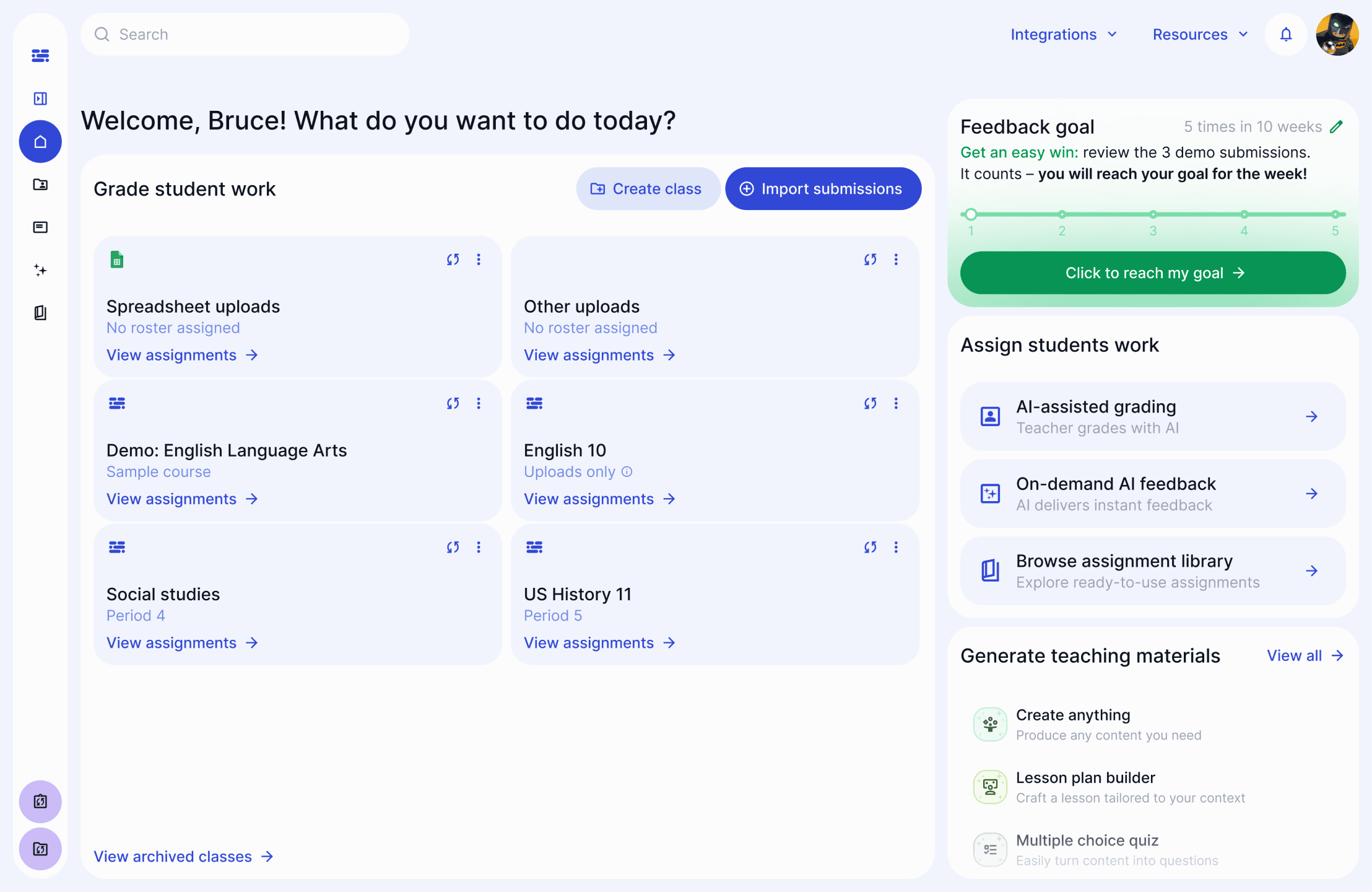
Weekend: The teacher runs the essays through EnlightenAI. Graded. Feedback generated. Trends identified. In minutes, not hours.
Friday: Peer review. Students read each other's work, apply the same writing checklist, and then compare their peer assessment to what EnlightenAI returned. Emily consistently finds that 90 to 95 percent of student peer grades align with the AI feedback, a result she says is the point: it trains students to internalize the rubric.
The magic of this workflow is not the technology. It is what the technology makes possible: students comparing their own self-assessment to AI feedback, and then comparing both to a peer's judgment. That is three lenses on one piece of writing, and it builds exactly the kind of metacognitive muscle that produces strong AP writers and, more importantly, strong thinkers.
The Vision: What Emily Is Building Next
Emily is not looking to maintain the status quo. She is looking to build something. For the coming school year, she has a clear architecture in mind for 9th grade history at KIPP New Orleans.
The plan starts with a diagnostic writing assessment at the beginning of the year, giving teachers baseline data before instruction even begins. From there, students work through weekly writing cycles anchored by a checklist that Emily built from AP-style DBQ rubrics. That checklist will be embedded directly into EnlightenAI's grading so that every piece of student writing, from the first week of school through final exams, is evaluated against the same standard.
She also wants to build student portfolios through the platform, so 10th grade teachers can open a folder and see not just a grade but actual writing samples showing how a student developed across the year. That kind of vertical alignment has always been a goal in theory. EnlightenAI makes it a practical possibility.
And she has ideas for how to use the platform's custom instructions to bake ACT English skills directly into writing feedback, flagging things like complex sentence structures and dependent clauses in the same pass that grades content. It is the kind of integration that gets to students in the moment they need it most, not weeks later.
The Region: What Emily's Work Made Possible
Emily did not just adopt EnlightenAI for herself. She became the proof of concept that made it safe for other teachers to try. She brought it into team meetings. She shared what worked and what did not. She modeled the spot-check process. And she was honest about the moment the tool got something wrong, which, counterintuitively, built more trust in the tool than any polished demo ever could.
Because of Emily's leadership, EnlightenAI is now operating across the entire KIPP New Orleans region. Teachers who started skeptical, the way Emily started, are now running their interim assessments through the platform, using the data to inform instructional planning, and giving students the kind of immediate, detailed written feedback that was previously only possible for the most dedicated, most senior teachers with the most experience and the most hours in the day.
That is what a foundational partner looks like.
One teacher can change how a whole department grades
Emily didn't wait for a district initiative. She walked her department through the tool in a single meeting, and by the end of it, every teacher had graded a class set. The adoption wasn't mandated, it was demonstrated. Showing works faster than advocating, and the results do the rest.
Start with one meeting, one tool, one class set, try the AI grading tool.
Consistent feedback across classrooms is harder than it sounds
Norming sessions help. Calibration meetings help. But they don't solve the fundamental problem: two teachers reading the same essay will still score it differently. Moving to a shared rubric in EnlightenAI meant feedback was finally consistent across Emily's department, in a way no professional development session had managed to achieve. When the grading tool is the same across classrooms, the feedback standard is too.
End the inconsistency across your department, try the AI essay grader.